
What Is Affiliate Marketing and How Does It Work?
Affiliate marketing is one of the most accessible and scalable revenue models in the digital economy. In simple terms, it is a performance-based arrangement in which a business rewards an individual or organization for driving measurable results—typically traffic, leads, or sales—through a unique tracking link. For technology companies, affiliates, and content publishers alike, it represents a mutually beneficial system built on accountability and alignment of incentives.
This article breaks down the mechanics of affiliate marketing, the key participants involved, the technology that powers it, and the strategies that separate high-performing programs from underperforming ones.
The Core Definition
Affiliate marketing is a commission-based partnership model where an affiliate promotes a merchant’s product or service and earns a payout when a predefined action is completed. That action may be a purchase, a free-trial signup, a newsletter subscription, or a software demo request. Because payment is tied directly to outcomes, the merchant bears little upfront risk, and the affiliate is incentivized to deliver qualified results.
In the technology sector, affiliate marketing is especially prevalent in SaaS, consumer electronics, cybersecurity, cloud hosting, and developer tooling—categories where buyers conduct extensive research before committing.
The Key Participants
A functioning affiliate ecosystem typically involves four parties:
- The merchant (advertiser): The brand or vendor that owns the product and pays commissions.
- The affiliate (publisher): The individual, creator, or website that promotes the offer.
- The consumer: The end user who clicks the affiliate link and completes the desired action.
- The affiliate network or platform: The intermediary that tracks clicks, attributes conversions, and manages payouts.
Each participant plays a distinct role, and the integrity of the system depends on transparent tracking and clear terms.
How Affiliate Marketing Works: A Step-by-Step Breakdown
The workflow is straightforward in principle but technically sophisticated in execution. The following sequence describes a typical transaction:
Modern attribution systems increasingly rely on server-side tracking, first-party identifiers, and multi-touch models to maintain accuracy as browser privacy restrictions limit traditional cookies.
Common Commission Models
Compensation structures vary by industry and objective. The table below summarizes the most common models used in technology programs.
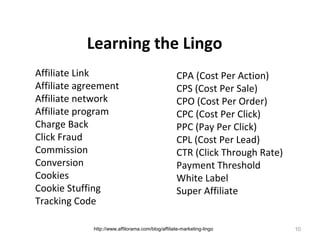
| Pay-per-sale (CPA) | Completed purchase | Consumer electronics, SaaS subscriptions |
| Pay-per-lead (CPL) | Form submission or trial signup | B2B software demos, cloud trials |
| Pay-per-click (PPC) | Validated click to merchant site | Content publishers, comparison sites |
| Recurring commission | Ongoing subscription renewals | Hosting, security suites, SaaS platforms |
Recurring models are particularly attractive in SaaS because they generate predictable, compounding revenue for affiliates and align long-term incentives with customer retention.
Why Affiliate Marketing Works
The model succeeds because it distributes risk and reward efficiently. Merchants gain access to niche audiences and credible third-party endorsements without large upfront advertising spend. Affiliates monetize expertise and traffic without inventory, customer support obligations, or fulfillment costs. Consumers, meanwhile, benefit from independent reviews and comparisons that inform purchasing decisions.
For technology brands, affiliates often function as an extension of the sales and marketing organization—reaching researchers at the exact moment of evaluation.
Key Success Factors
High-performing programs share several characteristics:
- Competitive, transparent commissions that reflect the value of each conversion.
- Reliable tracking infrastructure with accurate, timely attribution.
- Quality affiliate recruitment focused on relevant, credible publishers.
- Strong affiliate enablement, including creative assets, product updates, and dedicated support.
- Compliance enforcement to prevent fraud and ensure disclosure requirements are met.
Equally important is measurement. Program managers should monitor conversion rates, customer lifetime value by affiliate, and incremental lift—not merely click volume.
Conclusion
Affiliate marketing is a performance-driven growth channel that converts publisher trust into measurable business outcomes. By understanding the roles of merchants, affiliates, networks, and consumers—and by investing in accurate tracking and quality partnerships—technology companies can build a durable, scalable acquisition engine. For publishers, it offers a principled way to monetize expertise. Executed with transparency and rigor, affiliate marketing remains one of the most efficient models in digital commerce.