
How Affiliate Networks Connect Publishers and Advertisers
Affiliate marketing has matured into one of the most dependable performance channels in digital advertising, and at the center of that ecosystem sits the affiliate network. These platforms act as the connective tissue between two parties with complementary goals: advertisers seeking measurable results and publishers seeking monetizable inventory. Understanding how affiliate networks operate, what value they deliver to each side, and where they fit within a broader martech stack is essential for anyone building or scaling a performance marketing program.
The Core Function of an Affiliate Network
At its most fundamental level, an affiliate network is a technology platform and intermediary that facilitates relationships between merchants (advertisers) and affiliates (publishers). The network provides the infrastructure required to recruit partners, distribute offers, track performance, attribute conversions, and process payments. Rather than negotiating and integrating with each partner individually, advertisers join a network once and gain access to a curated pool of publishers, while publishers gain access to a catalog of offers from vetted brands.
This centralization reduces friction on both sides. Advertisers avoid the operational overhead of dozens of one-off contracts and technical integrations. Publishers avoid the burden of chasing individual merchants for payouts. The network absorbs that complexity and standardizes it.
How the Connection Works in Practice
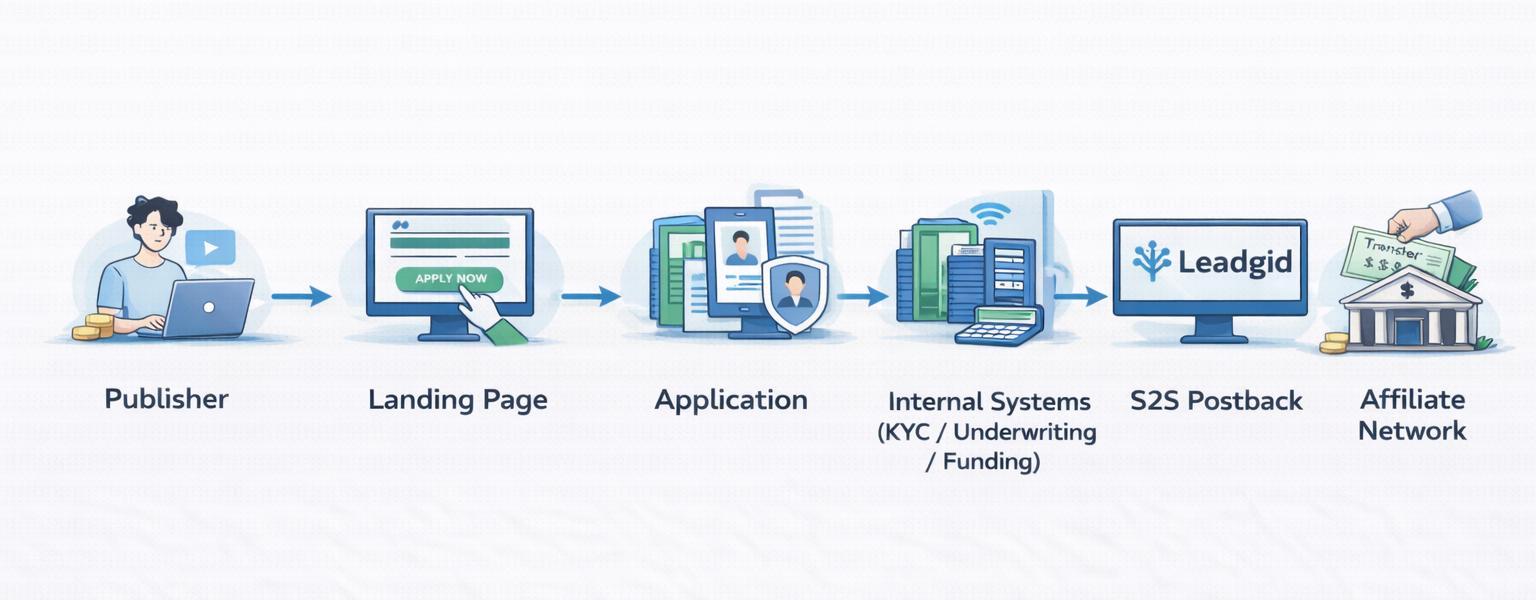
The mechanics of an affiliate network can be understood as a continuous cycle of offer distribution, tracking, and settlement. The table below summarizes the primary responsibilities the network assumes for each party.
| Partner recruitment | Access to vetted, pre-qualified publishers | Access to a portfolio of brand offers |
| Tracking and attribution | Accurate conversion data and fraud protection | Transparent, verifiable performance records |
| Payment processing | Consolidated invoicing across partners | Reliable, scheduled payouts |
| Compliance and quality control | Brand safety and policy enforcement | Protection from non-paying or unreliable merchants |
| Reporting and analytics | Performance insights by partner and channel | Conversion data to optimize campaigns |
Step 1: Offer Distribution and Recruitment
Advertisers publish offers to the network, defining commission structures, cookie windows, geographic restrictions, and creative assets. The network then surfaces these offers to relevant publishers through its interface, often supplemented by dedicated affiliate managers who match high-performing partners with suitable campaigns. Publishers apply to programs, and advertisers approve or reject applications based on their own criteria.
Step 2: Tracking and Attribution
Once a partnership is live, the network’s tracking technology records the entire customer journey. When a user clicks a publisher’s affiliate link, a tracking identifier is stored, typically via cookie or server-to-server integration. When a conversion occurs, the network attributes it to the correct publisher according to the advertiser’s defined rules. Modern networks layer in fraud detection, deduplication logic, and cross-device matching to protect advertisers from invalid traffic and to ensure publishers are credited fairly.
Step 3: Settlement and Reporting
On a scheduled basis, the network aggregates validated conversions, calculates commissions, and manages the flow of funds from advertiser to publisher. Both parties receive granular reporting that informs optimization decisions: advertisers identify which partners drive incremental revenue, and publishers identify which offers convert best for their audiences.
Why Advertisers Rely on Networks
Advertisers value affiliate networks for several reasons that extend well beyond simple matchmaking:
- Scalable reach: A single integration unlocks hundreds or thousands of potential partners.
- Pay-for-performance economics: Budget is spent against verified outcomes rather than impressions.
- Risk mitigation: Networks enforce compliance policies and absorb much of the fraud-prevention burden.
- Operational efficiency: Consolidated contracts, invoicing, and reporting replace fragmented partner management.
- Attribution clarity: Independent tracking provides a neutral source of truth for performance disputes.
Why Publishers Rely on Networks
For publishers, the network model solves the monetization problem at scale. Content creators, comparison sites, coupon platforms, and media properties can access brand partnerships that would be impractical to negotiate individually. Key benefits include:
The Network as a Trust Layer
Beyond technology, affiliate networks function as a trust layer in a market defined by information asymmetry. Advertisers cannot easily verify the quality of every publisher, and publishers cannot easily verify the solvency of every merchant. The network’s reputation, contractual framework, and dispute-resolution processes bridge that gap. This is particularly important in an era of increasing privacy regulation, where attribution windows are narrowing and the integrity of first-party tracking data is paramount.
Conclusion
Affiliate networks are far more than directories of offers. They are operational engines that recruit, track, verify, and settle, enabling advertisers and publishers to transact with confidence at scale. As performance marketing budgets face greater scrutiny and privacy constraints reshape measurement, the role of the network as a neutral, technology-driven intermediary becomes more valuable, not less. For advertisers and publishers alike, choosing the right network is a strategic decision that directly influences reach, efficiency, and long-term partnership quality.